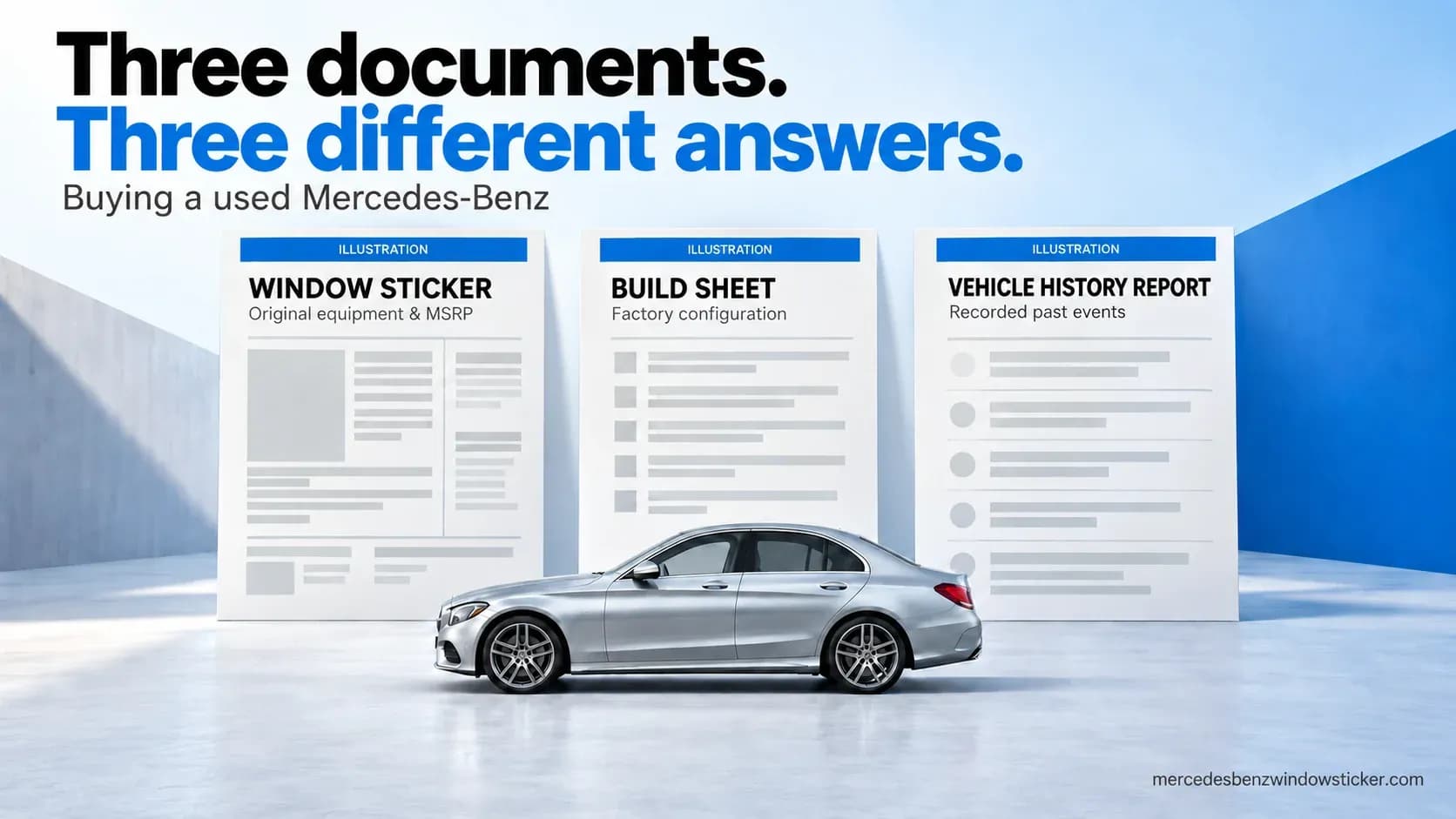

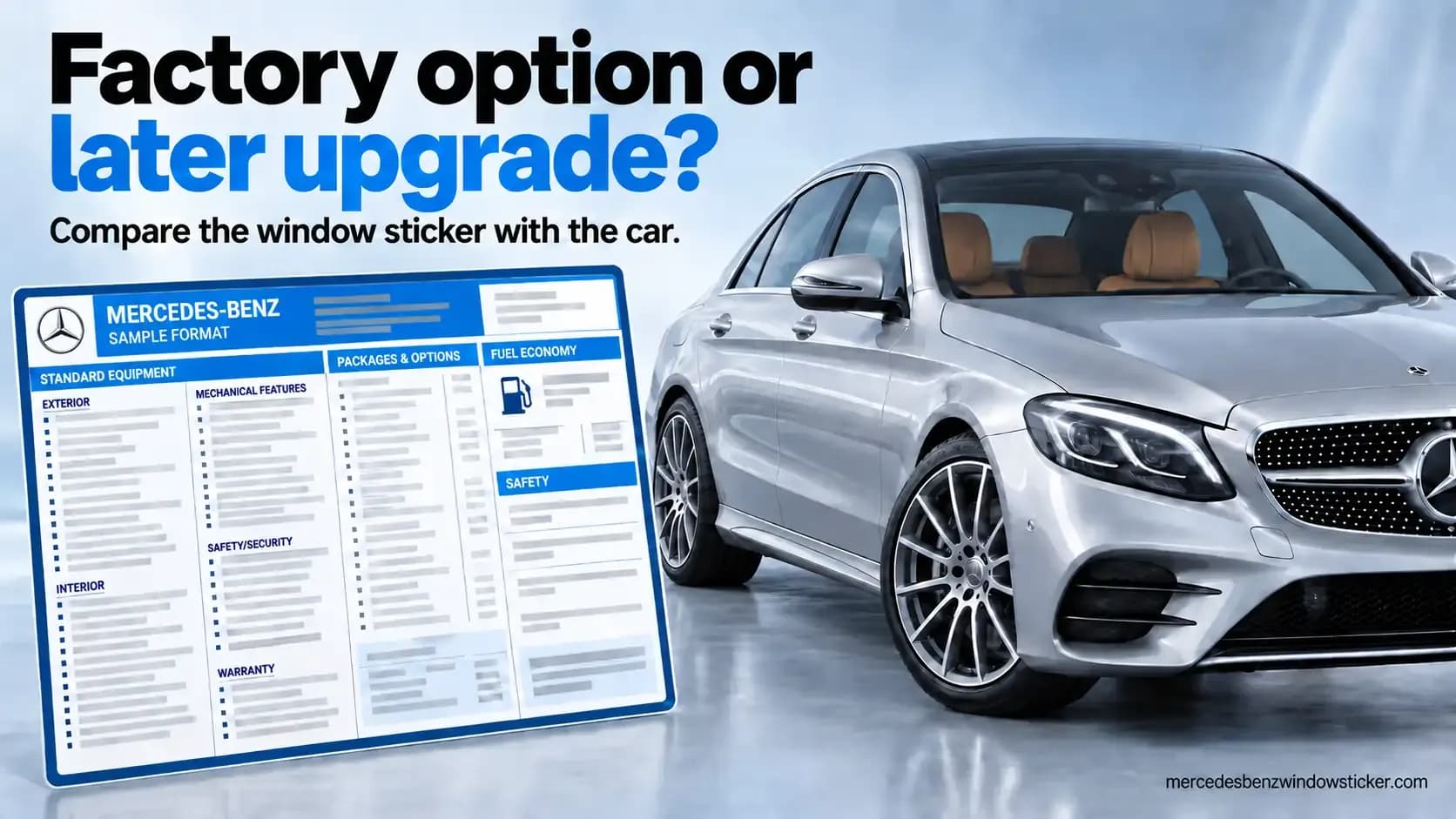
Mercedes-Benz factory options verification is the process of confirming which features and packages were part of a vehicle’s original configuration instead of relying only on its current appearance or the seller’s description.
The most useful approach is to check the original Monroney sticker that came with the car or retrieve a copy of the Mercedes-Benz window sticker by VIN, and compare those records with the equipment currently on the car.
Key Takeaways
- Check the Mercedes-Benz window sticker to establish the original equipment.
- Separate standard equipment, included features, and individually priced factory options before judging a seller’s claims.
- Compare the original configuration with the physical Mercedes because wheels, trim, badges, electronics, and other features can be changed later.
Why Verify Mercedes-Benz Factory Options Before Buying?
Factory options can affect how desirable a used Mercedes-Benz is, what equipment you expect to receive, and whether the seller’s description is accurate.
A listing might describe a vehicle as:
- Fully loaded
- AMG equipped
- Premium package
- Burmester audio
- Driver-assistance equipped
- Heated-seat equipped
- Factory upgraded
- Originally optioned with premium wheels
Those descriptions can sound convincing, especially when the equipment is visible on the car. But visible equipment does not always prove that it was installed as part of the original factory configuration.
Wheels can be replaced, badges can be added, interior pieces can be changed, and electronics can be retrofitted. That is why verifying Mercedes-Benz original equipment from factory records matters.
What Counts as Mercedes-Benz Factory Equipment?
Mercedes-Benz factory equipment generally refers to features associated with the vehicle’s original production and retail configuration. The information may include:
- Exterior color
- Interior color
- Upholstery
- Wheels and tires
- Engine and transmission
- Suspension equipment
- Comfort features
- Driver-assistance equipment
- Audio systems
- Navigation
- Parking technology
- Lighting
- Appearance packages
- Safety equipment
- Individual factory options
Standard Equipment
Standard equipment is included with the vehicle’s base configuration without being listed as a separately priced option. For example, depending on the specific Mercedes-Benz model and configuration, certain mechanical, safety, comfort, or interior features may already be standard.
Seeing an item on the vehicle therefore does not automatically mean the original buyer paid extra for it.
Included Equipment
Some equipment may appear as included rather than standard or separately priced. This can happen when a feature is associated with a particular package, trim, configuration, or other selected equipment. An included item still forms part of the original configuration, but it may not have its own individual price.
Individually Priced Factory Options
Other features can appear as separate options with their own original prices. These are particularly useful when verifying seller claims about expensive optional equipment.
A window sticker may identify the costs of each factory option. This gives much more context than simply seeing the feature on the vehicle today.
How to Check Mercedes Factory Options by VIN
The VIN is used to identify the specific vehicle whose factory information you want to retrieve.
When checking Mercedes factory options by VIN, the important goal is to obtain vehicle-specific configuration information rather than relying on a generic list of equipment available for that model.
Looking up the Mercedes-Benz factory options by VIN can help obtain a copy of the original Mercedes window sticker, which shows all available factory equipment associated with the specific car. Once retrieved, compare the sticker and the physical car.
How to Confirm Factory Options Using the Window Sticker
A Mercedes-Benz window sticker is particularly useful for verifying factory options because it helps place equipment, packages, and original pricing together in one sheet.
Once retrieved, this should be followed by a physical inspection of the vehicle to verify the factory-installed options.
Step 1: Confirm the Vehicle Information
Before checking individual options, confirm that the sticker belongs to the Mercedes you are researching. Review information such as:
- VIN (Vehicle Identification Number)
- Model and Model year
- Exterior and interior color
- Engine
- Transmission
The vehicle details should match when compared with the car being sold. If the sticker identifies a completely different color, engine, model, or vehicle, investigate before relying on any option information.
Step 2: Review the Standard Equipment
Next, identify the equipment listed as standard. This helps separate features that were included in the base vehicle from optional equipment. For example, a sticker may contain groups covering:
- Exterior equipment
- Interior equipment
- Mechanical features
- Safety and security equipment
This gives you a baseline for understanding what the Mercedes already included before extra-cost options were added.
Step 3: Review Packages and Optional Equipment
Move next to the specific packages and options, and look for:
- Option name
- Equipment description
- Whether it is standard, included, or separately priced
- Original price when available
This section is usually the most important when a seller claims the vehicle has valuable original equipment.
Step 4: Compare the Window Sticker With the Physical Vehicle
Once you know the documented original configuration, inspect the car. Compare items such as:
- Wheels
- Exterior color
- Upholstery
- Interior trim
- Audio system
- Heated-seat controls
- Steering-wheel equipment
- Cameras
- Parking equipment
- Driver-assistance equipment
- Lighting
- Appearance details
The goal is to determine whether the vehicle still appears consistent with its original configuration. A mismatch does not automatically mean something is wrong. The equipment may have been replaced, upgraded, repaired, or removed during the vehicle’s life. But the mismatch gives you something specific to investigate with the seller.
READ ALSO: How to Read a Mercedes-Benz Window Sticker: Best Guide
How to Read Factory Option Info on a Mercedes Window Sticker
One of the most useful parts when checking Mercedes factory equipment is understanding how individual features are categorized.
Do not simply scan the option names; read the status beside each item.
Read the Status Beside Each Option
A Mercedes window sticker may distinguish among standard equipment, included equipment, and separately priced options.
Standard
Standard generally means the equipment is part of the vehicle’s standard configuration. The feature may be factory-installed, but it was not necessarily an additional paid option.
Included
Included means the equipment forms part of the configuration without a separate individual charge shown for that item. It may be associated with another package or configuration choice.
Individually Priced
An individually priced option shows that the feature carried its own original charge. This is particularly useful when evaluating claims that a Mercedes was ordered with expensive optional equipment.
Example: Reading Factory Options on a Mercedes-Benz Window StickeR
The sample 2017 Mercedes-Benz E-Class window sticker shows why the distinction matters. Its equipment information includes different types of option status.
For example:
| Equipment | Status shown |
|---|---|
| Engine: 2.0L Inline-4 Turbo | Standard |
| Transmission: 9G-TRONIC Automatic | Standard |
| Wheels: 18" AMG 5-Spoke | Included |
| Blind Spot Assist | $550 |
| Heated Front Seats | $750 |
| Heated Steering Wheel | $250 |
| Burmester Surround Sound System | $850 |
| Rear View Camera | $300 |
| Parking Pilot | $750 |
| Burl Walnut Wood Trim | Included |
← Scroll horizontally to see more →
This tells a buyer much more than a simple equipment list. For example, the sticker indicates that the Burmester system was presented as a separately priced option, while the Burl Walnut Wood Trim was included in the configuration.
Both may be original equipment, but they do not represent the same type of factory option. That distinction becomes useful when a seller describes every desirable feature as an expensive upgrade.
How to Verify a Seller’s Factory Option Claims
Seller descriptions are useful starting points, but they should be treated as claims to verify rather than definitive factory records. Turn broad marketing language into specific questions.
If the Seller Says “Fully Loaded”
“Fully loaded” is not a precise factory term. Ask what equipment the seller actually means.
For example:
- Premium audio?
- Driver assistance?
- Heated seats?
- Parking technology?
- Upgraded wheels?
- Premium interior?
- Appearance package?
Then compare those individual features with the original equipment information. A Mercedes can have many desirable options without having every available feature.
If the Seller Claims Premium Factory Equipment
Suppose the listing specifically advertises:
- Burmester audio
- Heated steering wheel
- Parking assistance
- Premium wheels
- Blind Spot Assist
Check each item against the available factory option information. Do not assume that because four claims are correct, every claim in the advertisement is correct. Verify them individually.
If the Seller Says an Option Was Expensive When New
This is where the window sticker can be particularly helpful. Instead of relying on phrases such as: “This was a very expensive factory option,” look for the actual original option price when it is available. That turns vague marketing language into a verifiable vehicle-specific fact.
How to Tell Factory Equipment From Aftermarket Changes
A Mercedes-Benz can look very different years after leaving the factory. Owners commonly change cosmetic and functional components.
Wheels
Wheels are among the easiest components to replace. A used Mercedes wearing AMG-style wheels today does not automatically prove those wheels were part of its original configuration. Compare the current wheels with the documented option information.
Badges and Exterior Styling
Badges, grilles, body trim, spoilers, and appearance components can all be changed. Visual styling alone should not be treated as proof of original equipment. This is especially important when the vehicle’s appearance is being used to justify a higher asking price.
Interior Equipment
Interior components can also change over time. Compare the current interior with the original color, upholstery, trim, and equipment information where available. These include:
- Steering wheels
- Trim
- Infotainment components
- Speaker grilles
- Upholstery
- Decorative pieces
Technology and Convenience Features
Certain technology features can be added, replaced, or retrofitted.
So the presence of the features below should not automatically be treated as proof that the feature was factory-installed. Original configuration records provide the reference point.
- A screen
- Camera
- Parking sensors
- Audio components
- Lighting upgrades
Which Factory Options Are Most Important to Verify?
You do not need to investigate every small feature with equal intensity. Focus first on equipment that materially affects the seller’s description, your buying decision, or the value you place on the car.
High-Value Optional Equipment
The exact equipment available varies by Mercedes-Benz model and configuration. Features worth checking carefully can include vehicle-specific items such as:
- Premium audio
- Driver-assistance technology
- Premium seating equipment
- Heating or ventilation features
- Parking technology
- Upgraded wheels
- Suspension equipment
Appearance Packages
Appearance-related claims deserve particular attention because visual components are relatively easy to change. Verify whether the current appearance is supported by the original equipment information rather than relying on:
- Badges
- Wheels
- Grilles
- Exterior trim
- Seller terminology
Exterior and Interior Colors
Factory records can also help confirm the original color combination. If the original sticker identifies one exterior color but the Mercedes is now another color, the vehicle may have been repainted or wrapped.
That does not automatically make it a poor vehicle, but it is useful information to know before buying.
What To Do When the Car Does Not Match the Factory Options
A mismatch should trigger investigation, not an immediate conclusion. Ask what changed and why. Possible explanations include:
- Original wheels were replaced
- Equipment was upgraded
- Components were removed
- Accident repairs required replacement parts
- Interior pieces were changed
- The vehicle was repainted or wrapped
- The seller simply described the option incorrectly
What matters is whether the explanation makes sense and whether the seller represents the vehicle accurately.
Ask for Supporting Documentation
When an important feature does not match the original configuration, ask for available records such as:
- Parts invoices
- Upgrade receipts
- Repair records
- Previous photographs
- Dealer invoices
- Seller documentation
You may still decide that the modification is desirable. The important thing is knowing that it is a modification rather than mistaking it for original factory equipment.
What Factory Option Lookup Cannot Tell You?
Verifying Mercedes-Benz factory options answers one specific question: “How was this Mercedes originally equipped?”
It does not tell you everything about the vehicle today. Factory option information does not automatically establish:
- Current mechanical condition
- Whether every feature still works
- Quality of modifications
- Quality of previous repairs
- Accident history
- Maintenance quality
- Current market value
For instance, confirming that a Mercedes originally had Burmester audio tells you that the feature belonged to the original configuration. It does not prove the audio system still works correctly today. Likewise, confirming factory wheels does not tell you whether those wheels are damaged or whether they are still installed.
Conclusion on How to Verify Mercedes-Benz Factory Options
The best way to verify Mercedes-Benz factory options is to compare the documented original equipment with the Mercedes being sold today. Start by retrieving and checking the Mercedes-Benz window sticker by VIN for documented standard equipment, included features, packages, and individually priced options. After that, compare the documented configuration with the seller’s claims and the physical vehicle.
This helps buyers, enthusiasts, and car flippers verify what they are actually paying for instead of relying on badges, appearance, or advertising language alone.