
Key Takeaways
- Use a window sticker to verify original equipment, factory options, and MSRP.
- Get a build sheet to find factory or production-configuration information, usually interchangeable with a window sticker.
- Go for a vehicle history report to know about any recorded events that happened after the Mercedes was built and sold.
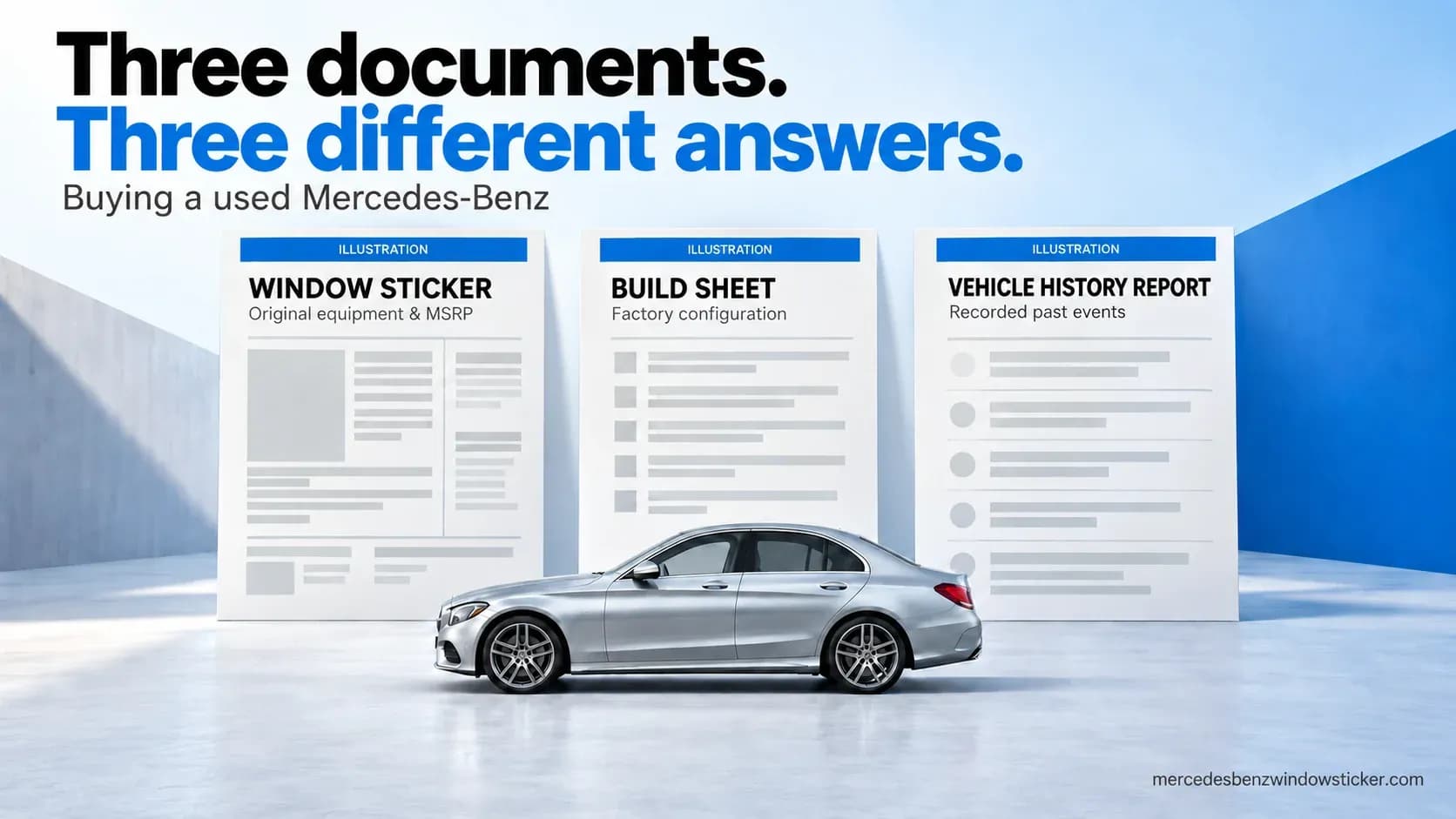
Comparing the window sticker, build sheet, and vehicle history report helps answer three different questions: what did the Mercedes cost when new?, how was it originally configured?, and what happened to it afterward?
A window sticker focuses on original equipment and suggested retail pricing, a build sheet focuses more on the vehicle’s factory configuration, while a vehicle history report covers recorded events during the car’s life, such as title changes, accidents, mileage, ownership, thefts, and more.
Window Sticker vs Build Sheet vs Vehicle History Report
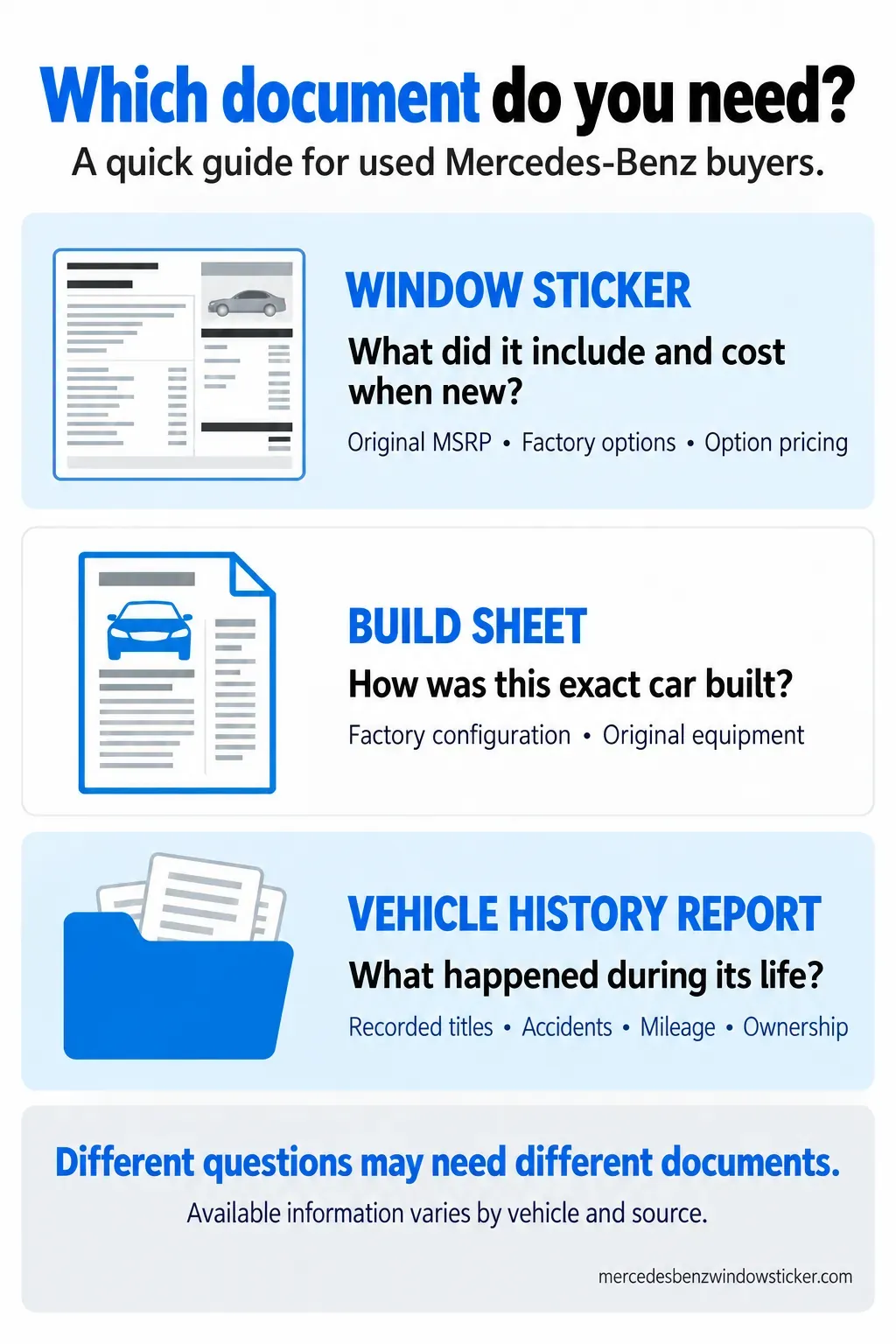
These three documents can overlap, but they are designed to answer different questions. Below is a table summarizing how each is useful during the purchase or sale of a used vehicle.
| Document | Main purpose | What’s Included |
|---|---|---|
| Mercedes window sticker | Original retail configuration | MSRP, standard equipment, factory options, colors, option pricing |
| Mercedes build sheet | Factory/build configuration | Vehicle-specific production and equipment configuration |
| Mercedes vehicle history report | Recorded history after production | Titles, accidents, damage, mileage, ownership, auctions, service records |
← Scroll horizontally to see more →
What Does a Mercedes Window Sticker Tell You?
A Mercedes window sticker is most useful when you want to understand the vehicle’s original features and options. It may show:
- VIN and model
- Exterior color
- Interior color and upholstery
- Standard equipment
- Mechanical equipment
- Safety equipment
- Factory options
- Packages
- Individual option prices
- Base MSRP
- Destination or shipping charge
- Total original vehicle price
This makes the window sticker particularly useful for used-car buyers trying to verify how a Mercedes was originally equipped. Sellers also use it for accurate listing and to boost buyers’ trust.
Original Factory Options
The window sticker can help distinguish between standard equipment, included equipment, and separately priced options. This is crucial, especially when a seller describes a used Mercedes as “fully loaded” or claims it has expensive factory upgrades. For example, a feature can be original equipment without having been an extra-cost standalone option.
Original MSRP and Option Pricing
The window sticker is also the strongest of these three documents when your question involves original retail pricing. It may show:
- Base MSRP
- Cost of individual factory options
- Destination charge
- Total vehicle price
That helps explain why two Mercedes-Benz vehicles from the same model and year may have had very different prices when new.
Original Color and Equipment Reference
A window sticker can also give you a baseline for comparing the original vehicle with its condition today. If the sticker identifies:
- One exterior color
- One interior combination
- A specific wheel configuration
- Certain factory options
…but the vehicle now looks different, you know something changed during its life. The sticker does not explain when or why the change happened. It simply establishes the original configuration. If original pricing and equipment are your main questions, getting the Mercedes-Benz window sticker by VIN is the most relevant starting point.
What Does a Mercedes Build Sheet Tell You?
A Mercedes-Benz build sheet is more focused on how the individual vehicle was configured for production. Exact fields can vary depending on the vehicle and available records, but the build sheet’s role is generally different from the window sticker’s retail-pricing role.
Factory Configuration
A build sheet may help identify vehicle-specific production or configuration details associated with the Mercedes. This makes it useful for buyers or enthusiasts who care less about what each option originally cost and more about questions such as:
- How was this vehicle originally configured?
- Which equipment belongs to the original build?
- Does the current vehicle still resemble its factory specification?
Equipment and Configuration Detail
A build sheet may overlap with a window sticker because both can describe original equipment. However, overlap does not make them interchangeable.
The build sheet is usually more relevant when the question is: How was this exact Mercedes built? While the window sticker is more relevant when the question is: What equipment did it have when sold, and how was that equipment priced?
What a Build Sheet Will Not Tell You
A build sheet is still an original-configuration source, but it should not be expected to tell you:
- Whether the vehicle later crashed
- Whether it received a salvage title
- How many owners it had
- Whether historical mileage is consistent
- Whether it appeared at auction
- Whether previous repairs were performed correctly
Mercedes Build Sheet vs Window Sticker: Why They’re Different
When comparing a Mercedes build sheet and a window sticker, emphasize the purpose of the information rather than asking which document is “better.”
Use the Window Sticker for Retail Context
The window sticker places factory equipment in the context of how the vehicle was originally offered for sale. It is more useful when you want to understand:
- Original MSRP
- Option prices
- Standard versus optional equipment
- Packages
- Exterior and interior colors
- Total original vehicle price
Use the Build Sheet for Build Context
The build sheet is more useful when you are researching the vehicle’s underlying factory configuration. It helps answer questions about the car as a specific production build rather than focusing primarily on original retail pricing.
Where They Both Overlap
The two important documents can help with:
- Original equipment
- Vehicle-specific configuration
- Colors or trim where available
- Factory-installed features
A window sticker explains the Mercedes as it was equipped and priced for retail sale, while a build sheet focuses more directly on how that specific vehicle was configured for production.
How to Read a Mercedes Build Sheet and a Window Sticker
When both forms of information are available, they can complement each other. The goal is not to compare them line by line looking for which document contains more data. Instead, use each one for the question it answers best.
Start With the Window Sticker for the Buyer-Facing Configuration
Use the Mercedes window sticker to review:
- Model
- Exterior and interior colors
- Standard equipment
- Factory options
- Packages
- Individual option pricing
- Original MSRP
Use the Build Information for Configuration Detail
Use the build information to understand the vehicle’s factory configuration more closely. If a current seller claims that a feature was factory-installed, the build information can provide additional context about the original specification.
Compare Both Sheets With the Physical Vehicle
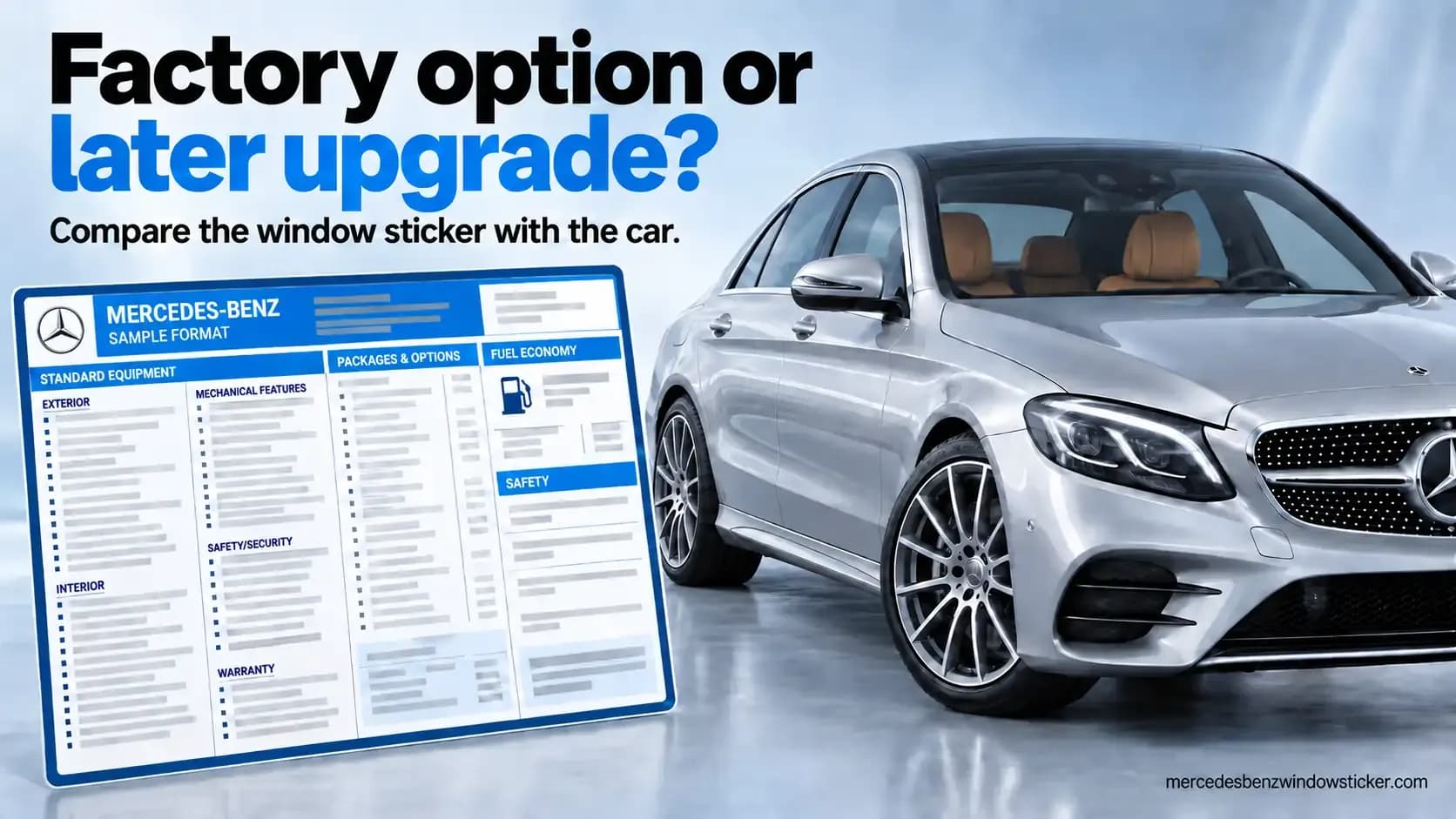
When considering a used Mercedes, ensure to compare the documented original configuration with the vehicle in front of you.
Look at the following details:
- Wheels
- Exterior color
- Upholstery
- Interior trim
- Audio equipment
- Comfort features
- Appearance equipment
If something does not match, that does not automatically make the vehicle problematic. A later owner may have replaced, modified, or upgraded equipment. The mismatch simply gives you something specific to investigate.
What Does a Mercedes-Benz Vehicle History Report Tell You?
Instead of explaining how the Mercedes was configured when new, a Mercedes-Benz vehicle history report looks at available records created during the vehicle’s life. It usually checks for the following records:
- Title brands
- Accident records
- Damage records
- Ownership history
- Vehicle usage
- Mileage records
- Auction history and images
- Service and maintenance records
- Lien or loan status
- Theft records
Title and Damage History
A vehicle history report may help identify title information and records such as:
- Salvage
- Rebuilt or rebuildable
- Accident events
- Damage information
- Insurance-related events.
Mileage and Ownership
A VIN history report can also help you examine:
- Recorded odometer readings
- Ownership periods
- Ownership changes
- Vehicle usage where available
Auction and Service Records
A history report may also show:
- Auction dates
- Auction condition
- Damage descriptions
- Auction photos
- Recorded service events
- Repair records
Build Sheet vs Vehicle History Report: Why They Are Not Interchangeable
A build sheet vs vehicle history report comparison is much simpler once you separate original configuration from later events.
Consider a Mercedes that left the factory with desirable equipment. The build sheet may help establish that original configuration, but it cannot tell you whether the Mercedes later:
- Was involved in an accident
- Received a branded title
- Changed owners several times
- Appeared at a salvage auction
- Developed questionable mileage records
Likewise, a vehicle history report may show those later events without giving you the same factory-configuration detail. So, both can be useful, but for different reasons.
Window Sticker vs Vehicle History Report: Any Difference?
The distinction between these two documents is particularly important for used-car buyers.
A Mercedes may have:
- A desirable original color
- Premium factory options
- Expensive original equipment
- A high original MSRP
The window sticker can help establish those facts, but a desirable original specification does not tell you whether the vehicle later developed a complicated history. The vehicle history report helps address the years after the original sale, showing records of accidents, title status, theft, ownership, and more.
Which Document Should You Use?
To know which document you need, choose based on the question you need answered. Here are some common questions a buyer might ask, and the documents that best answer each of them:
| Buyer’s Question | Best source |
|---|---|
| What was the original MSRP? | Window sticker |
| Which factory options were separately priced? | Window sticker |
| What were the original colors? | Window sticker |
| How was the vehicle configured for production? | Build sheet |
| What equipment belonged to the original build? | Build sheet |
| Was an accident recorded? | Vehicle history report |
| Does the vehicle have title-brand history? | Vehicle history report |
| Are historical mileage readings available? | Vehicle history report |
| How many ownership periods were recorded? | Vehicle history report |
| Did the Mercedes appear at auction? | Vehicle history report |
← Scroll horizontally to see more →
For many used vehicles, you may need more than one source because no single document answers every question.
Do You Need All Three When Buying a Used Mercedes?
Not necessarily. The documents you need depend on what matters to your purchase.
If Original Equipment and MSRP Matter Most
Start with the window sticker. It gives you the strongest retail-oriented view of:
- Original equipment
- Options
- Packages
- Colors
- Pricing
If Factory Configuration Matters Most
A build sheet becomes more useful when you want to understand the vehicle’s original build in more detail. This may be especially relevant to enthusiasts or buyers comparing the current car with its original specification.
If Past Events Matter Most
Use the vehicle history report when your concern is what happened after the vehicle had its first owner. This helps answer questions about:
- Accidents
- Titles
- Mileage
- Ownership
- Thefts
- Liens and loans, etc.
Conclusion
Comparing a window sticker vs build sheet vs vehicle history report is easiest when each document stays in its proper role. The window sticker explains original equipment and pricing, the build sheet focuses on factory configuration, and the history report covers recorded events that happened later.
For a used Mercedes buyer, the right choice depends on the question. Use original configuration documents to understand what the car started as, and history records when you need to understand what happened after it entered the road.