
A Mercedes VIN check checklist helps you verify that the vehicle is really what the seller says it is before you commit your money.
Start by matching the VIN across the vehicle and documents, confirm the vehicle identity, investigate its recorded history, and compare its original configuration with the Mercedes sitting in front of you. The goal is to catch inconsistencies before they become your problem.
Key Takeaways
- Always match the VIN number across the Mercedes, paperwork, and VIN-linked records before trusting the listing.
- Investigate mismatched VINs, unusual title or mileage patterns, and signs that a VIN label or document may have been altered.
- Use the VIN to verify both the vehicle’s recorded history and its original configuration, then confirm the car’s current condition with an independent inspection.
1. Match the VIN Before Checking Anything Else
The first step in a Mercedes pre-purchase VIN inspection is simple: make sure every VIN you are looking at belongs to the same vehicle.
For modern U.S.-market vehicles, the VIN is a standardized 17-character identifier that encodes information about a particular vehicle.
If the seller sends you a VIN before you visit the vehicle, keep it. You will want to compare that exact number with the vehicle and paperwork when you see the Mercedes in person.
Compare the VIN Across the Vehicle and Documents
Do not verify only one VIN location. The purpose of this step is to make sure the same vehicle identity appears consistently across several independent points.
The VIN on the Dashboard
Check the VIN visible through the windshield on the dashboard because one different character can connect your research to a completely different vehicle. Compare all 17 characters with the VIN provided in:
- The advertisement
- Seller messages
- Any report you already obtained
Vehicle Identification or Certification Label
Check the identification or certification label on the vehicle where applicable. The displayed VIN should agree with the VIN on the dashboard. If the numbers differ, don't try to explain the difference yourself. Stop the transaction until the vehicle's identity can be properly verified.
Title, Registration, and VIN Reports
Compare the VIN against available documents such as:
- Title
- Registration
- Dealer paperwork
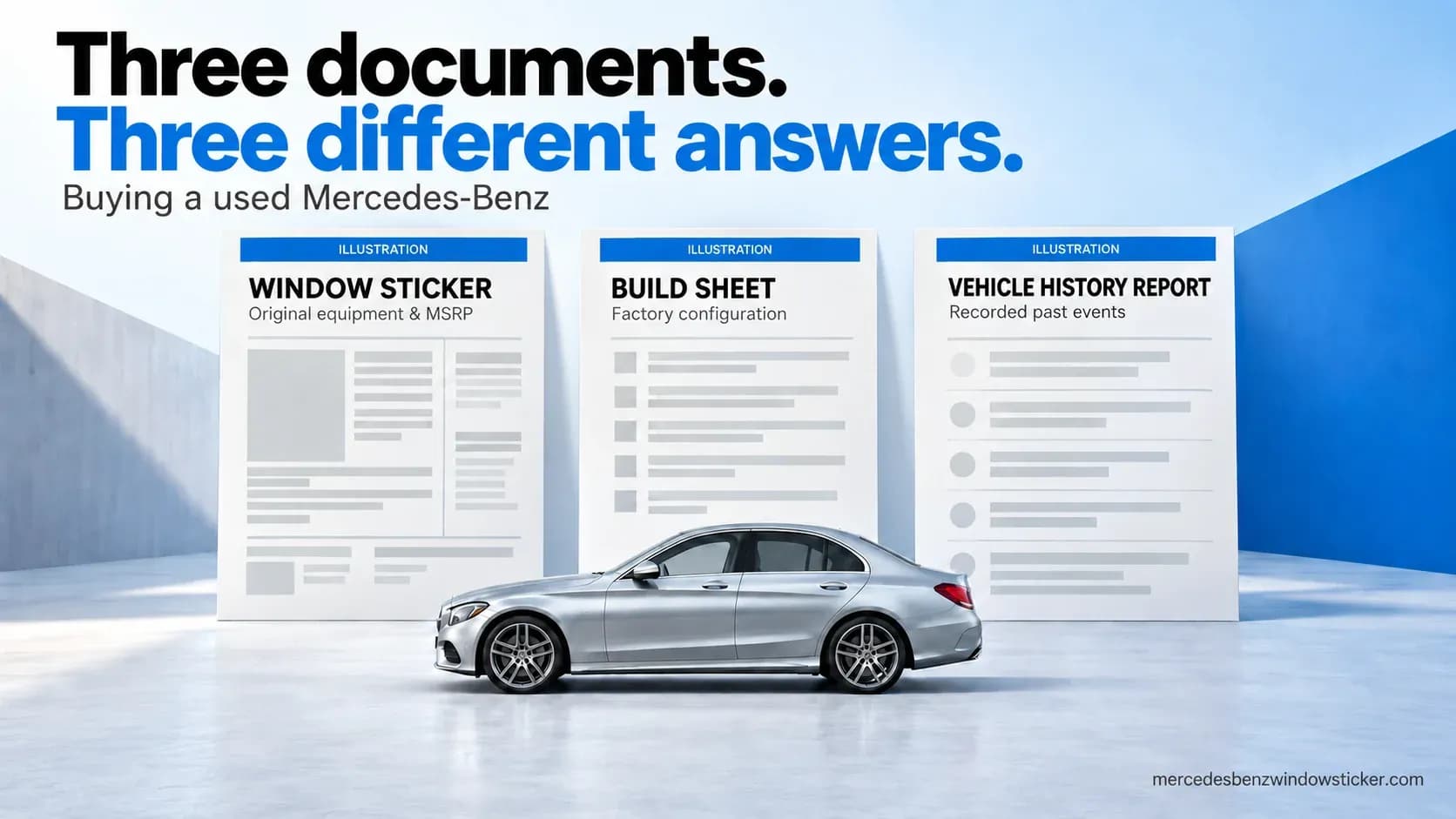
- Vehicle history report
- Insurance or seller documentation where relevant
A seller showing you a clean history report is not useful if the VIN on that report differs from the Mercedes being sold.
2. Confirm What Mercedes-Benz the VIN Identifies
Once the VIN matches across the vehicle and documents, confirm that its decoded vehicle information also makes sense. A Mercedes-Benz VIN decoder can help establish basic vehicle identity and available specifications.
You should compare information such as:
- Model year
- Model or series
- Engine
- Fuel type
- Drive type
- Body style
- Manufacturing information
Compare the Basic Information With the Advertisement
Suppose an advertisement describes the vehicle as a particular Mercedes-Benz model, engine, or drivetrain. The vehicle information decoded from the VIN should support that description. Investigate if the listing says one thing while the retrieved vehicle information says another.
For example:
- Different model year
- Different engine
- Different drivetrain
- Different body type
- Different model designation
A listing mistake is possible. But when buying a used vehicle, an unexplained identity mismatch should never be treated as a small detail.
3. Check for Signs of a Cloned or Fake Mercedes-Benz VIN
Knowing how to spot a cloned or fake Mercedes-Benz VIN is important because a vehicle can look legitimate while carrying the identity of another car.
VIN cloning involves copying the VIN of a legitimate vehicle and using that identity on another vehicle, often together with counterfeit documentation. NICB warns that this technique can be used to disguise stolen vehicles before they are sold to unsuspecting buyers.
What Are the Main VIN-Cloning Red Flags?
No single warning sign proves a vehicle has been cloned. You should become more cautious when several inconsistencies appear together.
Look for:
- VINs that do not match across the vehicle
- VIN on paperwork that differs from the physical vehicle
- Vehicle specifications that conflict with the VIN
- Suspicious or inconsistent title documents
- Unusual ownership patterns
- Seller resistance to VIN verification
- A price that appears unusually low without a convincing explanation
- History records that do not seem to fit the vehicle being sold
NICB recommends checking the VIN with appropriate government or motor-vehicle authorities and conducting a title search when purchasing a used vehicle.
Look Carefully at the VIN Area
An altered VIN is not always something an ordinary buyer can identify visually, so don't assume a label looks genuine simply because it appears neat. However, visible irregularities around identification labels or documents should increase your caution.
Possible reasons to investigate include:
- Identification labels that appear disturbed
- Inconsistent VIN information
- Documents that do not match the vehicle
- Vehicle information that conflicts with the displayed VIN
NICB notes that altered VINs and supporting documents are used in some stolen-vehicle and insurance-fraud schemes and recommends professional verification when alteration is suspected.
What Should You Do If You Suspect VIN Cloning?
Do not pay for the vehicle while its identity remains uncertain.
Instead:
- Recheck every VIN location and document.
- Run appropriate title and history checks.
- Check for stolen-vehicle information through appropriate official or insurance-crime resources.
- Ask the relevant motor-vehicle authority or law enforcement for verification when fraud is suspected.
- Walk away if the seller pressures you to complete the transaction before the discrepancy is resolved.
A bargain is not a bargain if you cannot establish that the seller has the right vehicle and valid ownership documentation.
4. Check the Mercedes-Benz Vehicle History by VIN
Once the vehicle identity appears consistent, use the VIN to investigate what has been recorded during the Mercedes' life. A Mercedes-Benz vehicle history report can provide available records connected to categories such as:
- Title history
- Accidents
- Damage
- Ownership
- Odometer reading
- Auctions records
- Service and maintenance
- Lien or loan records
- Theft information
- Other historical events
The FTC recommends obtaining a vehicle history report when buying a used car, while also cautioning that a history report is not a substitute for an independent inspection.
Check the Title History
Pay close attention to title-related information such as:
- Salvage
- Rebuilt or rebuildable
- Flood
- Junk
- Other title brands
A title brand does not automatically tell you whether you should buy the Mercedes. It tells you that you need to investigate why the brand appeared, what happened to the car, and what happened afterward.
Assess Accident and Damage Records
Do not read an accident entry in isolation. Check whether it connects with:
- Insurance loss
- Damage reports
- Title changes
- Auction activity
- Repair documentation
If you need to evaluate these records in more detail, see How to Read a Mercedes-Benz vehicle history report.
Check Ownership and Usage Patterns
Review:
- Number of ownership periods
- Length of ownership
- Location
- Usage type where available
- Events surrounding ownership transfers
Multiple owners are not automatically a problem. What matters is whether the ownership pattern makes sense alongside the vehicle's mileage, title, accident, and sale history.
5. Check the Mileage Timeline for Inconsistencies
Mileage should be reviewed as a sequence, not just as the number currently displayed on the dashboard. Historical odometer readings may appear through:
- Registration or title events
- Dealer inventory
- Auctions
- Service events
- Other reported records
Look for Mileage That Moves Backward
For example:
| Record | Mileage |
|---|---|
| Earlier record | 38,500 ✅ |
| Later record | 52,300 ✅ |
| Newer record | 41,900 ⚠️ |
← Scroll horizontally to see more →
That sequence needs explanation. It may indicate:
- An odometer issue
- Incorrect data entry
- Reporting error
- Another discrepancy requiring verification
Do not automatically accuse the seller of odometer fraud based on one unusual record.
Instead, compare multiple independent records.
Look for Unusual Mileage Gaps
A mileage sequence can move in the correct direction and still raise questions.
Suppose:
- A historical record shows 60,000 miles five years ago.
- The Mercedes now shows 62,500 miles.
That could be legitimate. But such low usage deserves supporting context.
Compare it with:
- Service receipts
- Registration records
- Auction information
- Seller documentation
- Current vehicle condition
6. Use the VIN to Verify the Mercedes' Original Configuration
A used Mercedes-Benz pre-purchase checklist should also answer another important question: Does the vehicle being sold still match its original configuration? This is where the VIN becomes useful beyond basic identity.
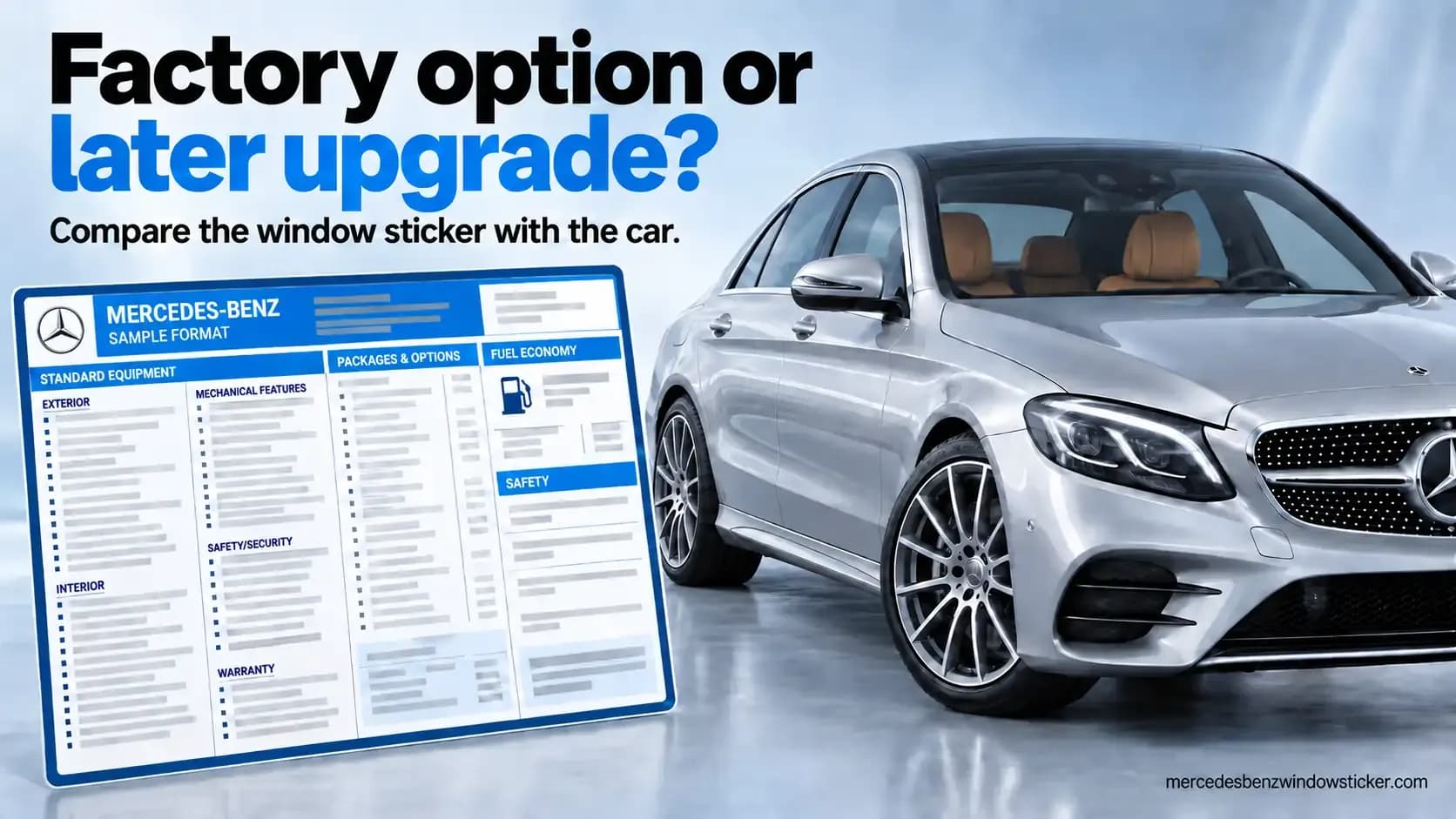
Finding the Mercedes-Benz window sticker by VIN can help you review available information about the Mercedes' original configuration, including items such as:
- Exterior color
- Interior color
- Standard equipment
- Factory options
- Packages
- Mechanical equipment
- Original MSRP
- Individual option pricing where available
Compare Original Equipment With the Seller's Claims
Pay particular attention when the advertisement makes claims such as:
- Fully loaded
- Premium package
- Factory upgraded
- Premium audio
- Driver-assistance equipped
- Heated-seat equipped
- Upgraded factory wheels
Rather than relying on advertising language, compare those claims with the available vehicle-specific equipment information.
Check Whether the Car Still Matches the Original Configuration
Original records establish how the Mercedes was configured. The physical vehicle tells you what is installed today.
Compare:
- Exterior color
- Interior and upholstery
- Wheels
- Audio equipment
- Comfort features
- Appearance equipment
- Other important options
A mismatch is not automatically bad. A previous owner may have replaced wheels, changed trim, wrapped the vehicle, or modified equipment. The important thing is knowing what is original and what changed later.
7. Check for Recall Information based on the VIN
A pre-purchase VIN check should also include unresolved safety recalls. Recall campaigns can apply to particular groups of vehicles, so the relevant buying question is not simply whether the model has ever been recalled.
You want to know whether the specific VIN has an applicable unrepaired safety recall.
NHTSA (National Highway Traffic Safety Administration) provides VIN-based recall information for unrepaired safety recalls, and the FTC (Federal Trade Commission) also recommends checking recalls before purchasing a used car.
If a recall appears, determine:
- What component is affected
- Whether the campaign applies to the specific car using the VIN
- Whether the repair remains open
- What documentation shows if the repair was completed
A recall is not necessarily a reason to reject the vehicle, but unresolved safety work should not be ignored.
8. Compare the VIN Check Report With the Seller's Documents
Once you have gathered VIN-linked information, compare it with what the seller is actually giving you. Look for agreement between:
- VIN
- Vehicle identity
- Title
- Registration
- Mileage
- Ownership story
- Original configuration
- History records
- Seller description
Ask Specific Questions About Mismatches
Avoid asking generally. E.g., Is everything correct? Rather, ask: The history report shows a title change shortly after an accident. What happened during that period? Or the original configuration shows different wheels. When were the current wheels installed?
Specific questions are more useful because they connect directly to evidence.
9. Know the Biggest Red Flags When Buying a Used Mercedes-Benz
Some inconsistencies deserve more attention than others.
| Red Flag | Why it Matters | What to Do |
|---|---|---|
| VIN differs between vehicle locations | Could indicate an identity problem | Stop and verify before paying |
| VIN and title do not match | Ownership or identity may be questionable | Do not proceed until resolved |
| Decoded vehicle differs from listing | Seller description or vehicle identity may be wrong | Investigate the discrepancy |
| Suspicious VIN/document appearance | Could indicate alteration or cloning | Seek official/professional verification |
| Salvage/rebuilt history not disclosed | Major transparency issue | Investigate cause and repairs |
| Mileage moves backward | Possible odometer or reporting discrepancy | Compare several records |
| Seller refuses VIN checks | Prevents basic due diligence | Consider walking away |
| Seller's option claims don't match original configuration | Equipment may have been modified or misrepresented | Ask for documentation |
| History conflicts with seller's story | Creates a trust problem | Require evidence |
| Seller refuses independent inspection | Prevents current-condition verification | Consider another vehicle |
← Scroll horizontally to see more →
These red flags when buying a used Mercedes-Benz do not all mean fraud. They mean that you shouldn’t explain away the inconsistency before you have evidence.
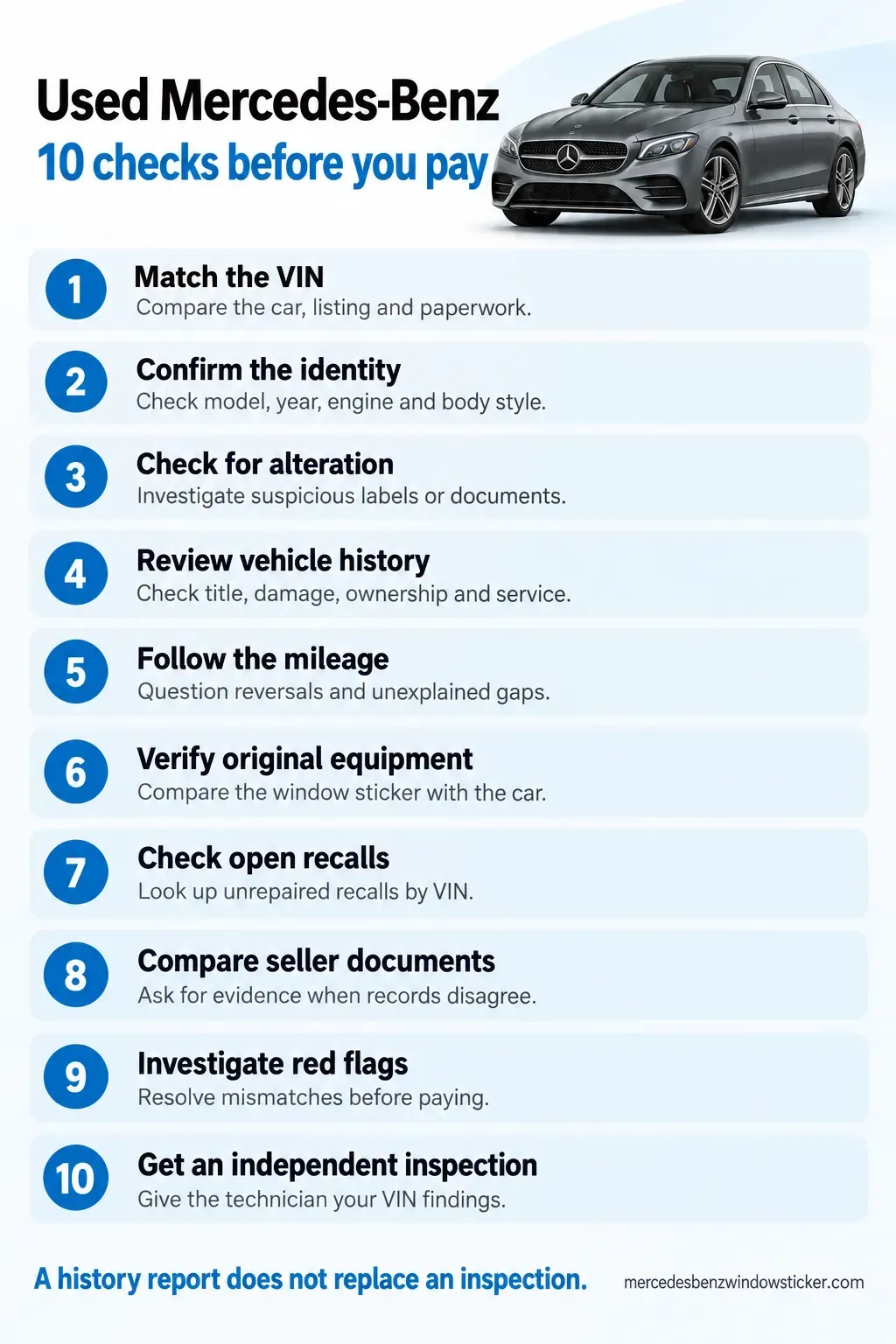
10. Complete the VIN Check With an Independent Inspection
A VIN check tells you about identity, configuration, and available historical records. It does not tell you the complete current mechanical condition of the Mercedes.
A history report may identify an accident, but it cannot automatically determine whether the resulting repair is structurally sound today. The FTC recommends an independent inspection even when a vehicle history report has already been obtained.
Give the Inspector the VIN Findings
Don't treat the inspection and VIN lookup as unrelated steps. Inform the technician of whatever the research finds. These include:
- Previous front-end damage
- Auction damage
- Flood history
- Mileage concerns
- Previous major repair events
The history can help the inspector focus attention on areas that deserve additional scrutiny.
Conclusion on Used Mercedes-Benz VIN Check Checklist
A used Mercedes VIN check checklist should do more than confirm that a VIN returns a valid model. Before buying, make sure the VIN is consistent across the Mercedes and its documents, verify that it identifies the vehicle being advertised, get the vehicle history report and investigate title history, review the mileage timeline, and compare the original configuration with the car you are actually considering.
Pay particular attention to mismatched VINs, suspicious documents, undisclosed title history, unexplained mileage changes, and seller claims that conflict with vehicle-specific records. Then use what you learned to guide an independent inspection.